Other Parts of This Series:
- Part 8: Journey To Database World: Part 8 (Column Family Database - Cassandra As Example)
- Part 10: Journey To Database World: Part 10 (Vector Database - Qdrant As Example)
Graph Database - Neo4j (Photo Credit: LinkedIn Image)
Story:
In a magical city called GraphLand, everything is connected in unique and meaningful ways. The city is home to people, places, and things, each playing a special role of relationships that define life there.
Rahmat is one of the residents of GraphLand and loves spending time at the cozy Central Library, where she enjoys reads books like “The Great Adventures”. Nilima is Rahmat’s girlfriend and loves to read the “Star War”. In GraphLand, these connections are not random; they form the essence of how the city works. Rahmat is connected to Nilima through their friendship. Also both linked to the Central Library.
What makes GraphLand magical is how easy it is to understand these connections. If someone wants to know who Rahmat’s friends are or what Nilima enjoys, they can easily trace the relationships and find the answers. The city doesn’t just store information about its residents and places, it organizes and connects everything in a way that makes exploration natural and easy.
What is a Graph Database?
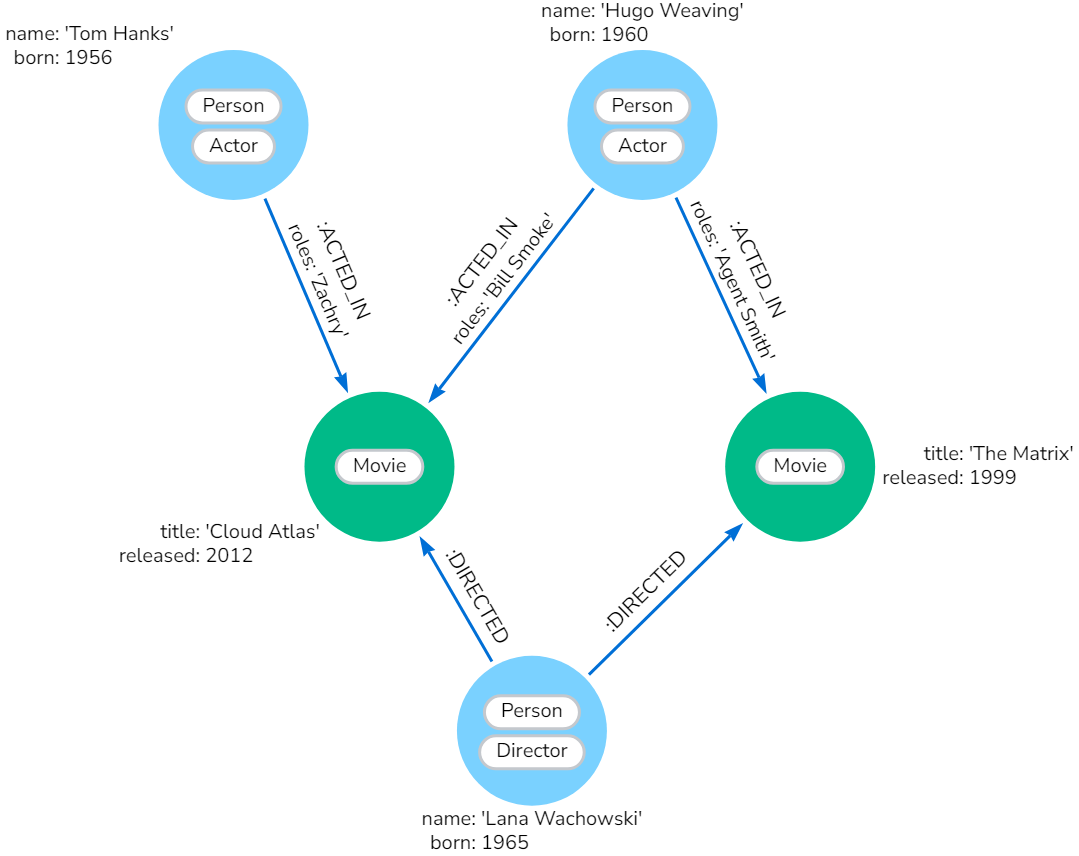
A graph database is a database designed to manage and store data in a graph-like structure, using nodes (entities) and edges (relationships) to represent and traverse data. Each node and edge can have properties (key-value pairs) that add descriptive information.
Key Components:
- Nodes: Represent entities (e.g., users, products, places).
- Label: A tag for categorizing nodes (e.g., Person, Product).
- Edges (Relationship): Represent relationships between nodes (e.g., “FRIENDS_WITH”, “PURCHASED”).
- Properties: Metadata stored in nodes or edges (e.g., name, age, transaction amount).
- Graph: A collection of interconnected nodes and edges.
Graph databases are particularly suited for scenarios where relationships between data points are as important as the data itself.
Graph database modeling (Photo Credit: Google)
Use Cases of Graph Databases
Social Networks:
- Represent users and their connections.
- Analyze relationships, find influencers, and suggest friends.
Recommendation Systems:
- Suggest products or services based on user preferences and social connections.
- Example: Movie recommendations on streaming platforms.
Fraud Detection:
- Identify anomalies and suspicious patterns in transactions.
- Detect relationships between entities involved in fraudulent activities.
Knowledge Graphs:
- Represent complex relationships, such as linking concepts in research, medicine, or AI.
Supply Chain Management:
- Model supplier relationships and optimize logistics networks.
Network and IT Operations:
- Visualize dependencies in IT infrastructure.
- Perform impact analysis and optimize configurations.
Benefits of Graph Databases
- Relationship-Centric: Designed to handle and traverse relationships efficiently.
- Flexible Schema: Adapts to changing data structures without the need for complex migrations.
- High Performance: Excels in queries involving deep relationships, such as shortest paths and recommendations.
- Natural Representation: Models real-world relationships intuitively (e.g., user-product interactions).
- Scalable: Handles large datasets with high interconnectivity.
- Visualization: Supports visual exploration of data, making analysis easier.
Drawbacks of Graph Databases
- Complexity: May be overkill for simple or flat data models.
- Specialized Expertise: Requires knowledge of graph theory and graph query languages (e.g., Cypher).
- Limited Ecosystem: Compared to relational databases, the ecosystem of tools and integrations may be smaller.
- Scalability Limitations: For extremely large-scale datasets, performance can degrade if not optimized properly.
- Lack of Standards: Unlike SQL for relational databases, there is no universal query language across graph databases.
When to Use a Graph Database
Highly Connected Data:
- When relationships between data points are critical.
- Example: Social networks, fraud detection.
Complex Queries:
- When queries involve traversing multiple levels of relationships.
- Example: Recommending products based on a friend-of-a-friend relationship.
Dynamic Data Models:
- When the data structure is expected to evolve over time.
- Example: Expanding a knowledge graph with new categories.
Real-Time Insights:
- When you need quick insights on connected data.
- Example: Real-time network monitoring.
When Not to Use a Graph Database
Flat Data:
- When data is not interrelated or can be represented as tables.
- Example: Simple sales records.
Transactional Workloads:
- When the focus is on high-volume, transactional operations (e.g., banking systems).
Massive, Unconnected Data:
- When data is primarily stored and queried as separate entities without relationships.
- Example: Log data with minimal cross-referencing.
Limited Expertise:
- If your team lacks familiarity with graph databases and their paradigms.
Neo4j as a Graph Database
Neo4j is a leading graph database that uses Cypher Query Language (CQL) for managing and querying data. It’s known for its performance, scalability, and developer-friendly design.
Features of Neo4j:
- ACID Compliance: Ensures data consistency and reliability.
- Visualization Tools: Intuitive data visualization for exploring graphs.
- Extensibility: Integrates well with other databases and platforms.
- Graph Algorithms: Built-in algorithms for traversal, clustering, and pathfinding.
- Scalability: Supports distributed graphs for large datasets.
Neo4j CQL Operations
Creating Nodes
Creating Relationships
Querying Data (Find all nodes of a type)
| |
Querying Data (Find relationships)
| |
Filtering Queries
Updating Data
Deleting Data
Advanced Queries (Find shortest path)
Advanced Queries (Recommendation System)
Create Index
Summary
Graph databases like Neo4j are designed for handling highly connected data, offering advantages in performance, flexibility, and intuitive modeling. While they shine in use cases like social networks, recommendation systems, and knowledge graphs, they may not be the best choice for flat or transactional data models. Neo4j is a prominent graph database with robust features and a developer-friendly approach, making it an excellent choice for graph-based applications.