Resume/CV Writing (Photo Credit: Naukri.com)
A software engineering CV/Resume is not just a document listing technologies and job history. It is a marketing document that should answer one core question:
“Why should this engineer be interviewed?”
So, understanding the characteristics of a effective Resume is equally important to understanding the company and role you are going to interview for.
Why Does a Great Resume Matter?
A great resume matters because it acts as:
Your professional introduction, marketing document, and opportunity generator — all at the same time.
It is usually the first impression a company has about you. Before interviews, coding rounds, technical discussions, system design evaluations, your resume decides whether you get the opportunity to express you at all.
For software engineers, a resume is not just a document — it is a professional representation of:
- your technical ability,
- your impact,
- your growth,
- your ownership mindset,
- your leadership capability,
- your communication,
- and your engineering maturity.
A strong resume helps you:
- get interviews,
- attract recruiters,
- pass ATS screening,
- stand out among hundreds of applicants.
On the other hand, a weak resume can hide even very strong engineers.
The Goal of a Resume
A resume is NOT:
- a biography,
- a technology dump,
- a full career history,
- a document to list everything you know.
A resume IS:
- a concise professional story,
- a proof of capability,
- a demonstration of impact,
- an interview invitation.
Things to Need to Consider Before Preparing a Resume:
Know the target role — Your resume should align with the responsibilities and expectations of the role you are applying for.
Understand your career level — Freshers, mid-level, senior, and lead engineers require different resume focus areas.
Identify your strongest selling points — Highlight the skills and experiences that differentiate you from other candidates.
Focus on impact, not only responsibilities — Companies care more about outcomes and business value than task lists.
Collect measurable achievements — Numbers make accomplishments more credible and easier to understand.
Understand the company/domain — Tailoring your resume to the company increases relevance and shortlist chances.
Prioritize relevant experience — Recruiters should quickly see the most important and relevant information first.
Decide the resume length early — Freshers should usually keep it to 1 page; experienced engineers to 2 pages.
Choose a clean and readable format — A well-structured resume improves readability and professionalism.
Organize technical skills logically — Grouped skills are easier to scan and look more professional.
Think about ATS compatibility — Simple formatting and relevant keywords improve ATS screening success.
Prepare a strong professional summary — The summary should quickly communicate your expertise and value.
Highlight career progression clearly — Promotions and increasing responsibilities demonstrate growth and trust.
Balance responsibilities and accomplishments — Strong resumes show both what you owned and what you achieved.
Select only relevant projects — Projects should support the role you are targeting, not just fill space.
Add leadership signals if experienced — Mentoring, ownership, and cross-team collaboration strengthen senior-level profiles.
Remove outdated or weak content — Old or irrelevant information reduces resume quality and focus.
Use action-oriented language — Strong verbs make accomplishments sound confident and impactful.
Keep the resume concise and high-signal — Recruiters prefer resumes that are easy to scan quickly.
Proofread grammar and formatting carefully — Small mistakes can reduce professionalism and credibility.
Include professional links — LinkedIn, GitHub, portfolio, or blogs strengthen your technical profile.
Ensure consistency everywhere — Consistent tense, formatting, and wording improve readability.
Avoid technology dumping — Listing too many tools without proof weakens credibility.
Think from a recruiter’s perspective — Your resume should quickly answer why you are worth interviewing.
Align the resume with your long-term career direction — Your resume should position you for the role you want next, not only the role you have now.
Writing The Resume
1. Common
- Format Correctly: proper alignment, line height, space gap, underline, bold, etc.
- Maintain Consistency: use consistent and concise formatting throughout the full resume.
- Font Size: use a common font size for texts, another for sub-headers, and another for headers.
- Page: use 1 page for freshers or less experienced engineers and 2 pages for experienced engineers.
- Section Ordering: order sections based on experience level.
- Grammer: avoid any kind of grammer mistakes.
- Personal Information: avoid adding irrelevant personal information as much as possible.
- File Name & Format: name the resume with your name and use .pdf format.
2. Resume Structure
Recommended Structure (Freshers)
- Header + Links
- Professional Summary / Objective
- Education
- Technical Skills
- Projects
- Internship / Experience
- Competitive Programming / Achievements
- Certifications / Additional Info
Recommended Structure (Experienced Engineers)
- Header + Links
- Professional Summary
- Work Experience
- Technical Skills
- Projects
- Education
- Competitive Programming / Achievements
- Certifications / Additional Information
Let’s see how we can prepare every section effectively.
Please note: the example given below is more appropriate for experienced engineers. But freshers can gather a good understanding, hopefully.
Header
In header you should place your full name and title, all the requeired contact info (like: address, phone, email), and links that can represent you further (like: portfolio website, LinkedIn, github).
Use a suitable font size: 11 for text, 12 for title, and 16 for full name. This section is the same for freshers and experienced engineers.
Example: Header
Professional Summary
The summary should quickly answer some of the questions, like who you are, years of experience, specialization, impact, leadership level, etc. Summarize yourself and your career/experience in brief. So that anyone feels interested to read the resume further and know you.
Freshers should emphasize their education and achievements. And experienced engineers should emphasize their career journey and impact.
Example: Summary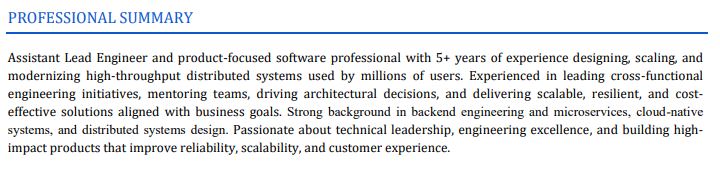
Work Experience
Listing your work experience in descending order. Don’t just write the jobs or responsibilities; show the impact you generate in your role. Use action-oriented verbs to make it powerful. Quantify your impact or achievement whenever possible. Mentioning the tech stack will be helpful.
For freshers, this section is naturally not relevant. But for experienced engineers, it is the section with the most meaning. If possible, list experience in a way that represents the growth or promotion nicely.
Example: Experience-1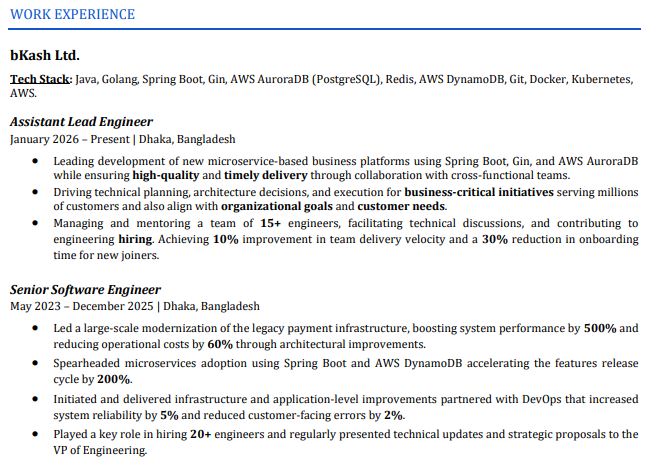
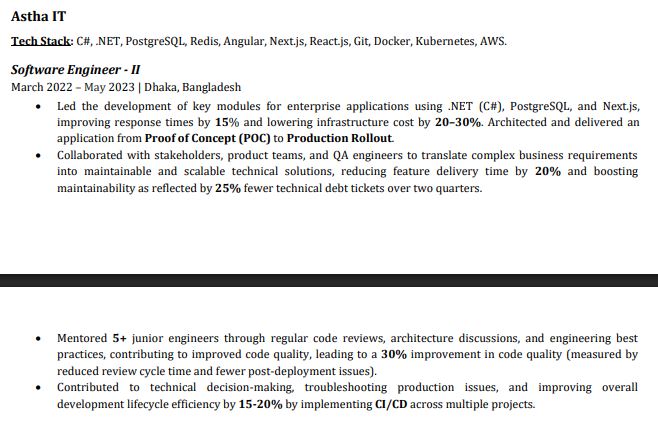
Experience-2
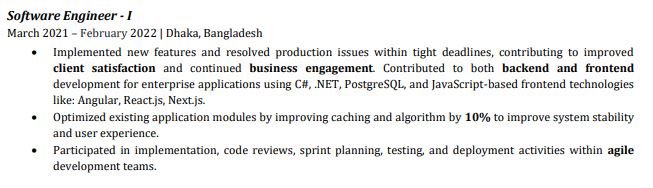
Experience-3
Technical Skills
Show the technical capability you have. List the technologies you are confident about, and avoid including anything you barely know. Group skills logically as much as possible.
Order them wisely, listing the technologies you most know first. Freshers should showcase their technical learning here.
Example: Skills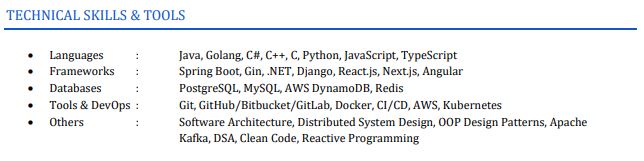
Projects
List highly impactful and successful projects in terms of business that you work with. Add links if possible. Order them wisely, listing the most recent and impactful one first.
For freshers, it is the section to showcase your pet projects and real-world working capability. Keep that section at the top after the education section.
Example: Projects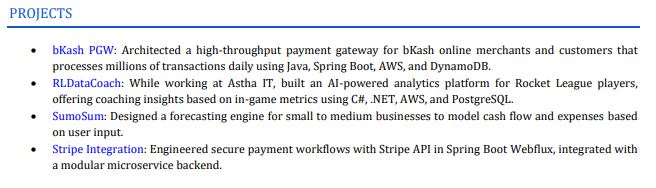
Education
List only the most recent 1 or 2 degrees. Show CGPA if it’s mentionable. Keep the section small and concise.
For freshers, keep that section at the top after the summary section.
Example: Education
Competitive Programming
Programmers with contest programming or competitive programming get extra care in the community. So, if you have the competitive programming background, you should keep it on your resume.
Example: Competitive Programming
Additional Info
Showcase your personal achievements, extracurricular activities, blogging links, hobbies, etc. But all the information you provided in this section should emphasize your previously given data.
Example: Additional Info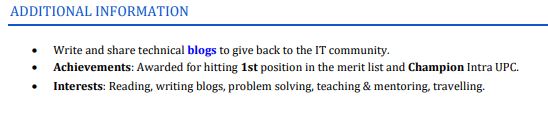
Common Resume Mistakes
- Using a generic resume for every job — Recruiters can tell when your resume isn’t tailored to the role.
- Writing a long objective statement — Hiring managers care more about your value than your career wish list.
- Including irrelevant experience — Unrelated details distract from your strongest qualifications.
- Listing duties instead of achievements — Results and impact are more impressive than task descriptions.
- Using vague buzzwords — Terms like “hardworking” or “team player” mean little without proof.
- Having spelling or grammar mistakes — Errors make you look careless and unprofessional.
- Making the resume too long — Recruiters often scan resumes for only a few seconds.
- Using poor formatting — Cluttered layouts are hard to read and may confuse ATS systems.
- Adding too much personal information — Details like age, religion, or marital status are unnecessary.
- Using an unprofessional email address — A casual email can hurt your professional image.
- Not including keywords from the job description — ATS software may reject resumes missing relevant terms.
- Including outdated skills — Old or irrelevant skills can make your profile seem outdated.
- Exaggerating or lying — False claims are often discovered during interviews or background checks.
- Using paragraphs instead of bullet points — Dense text reduces readability and quick scanning.
- Ignoring measurable results — Numbers help employers understand your real impact.
- Adding references directly on the resume — It wastes space since employers ask only if needed.
- Using inconsistent fonts or styles — Inconsistency makes the resume look unpolished.
- Leaving unexplained employment gaps — Recruiters may assume the worst without context.
- Submitting the wrong file format — Some formats break formatting or fail ATS compatibility.
- Not updating contact information — Employers can’t reach you if details are outdated.
Final Resume Checklist
Before sending a resume, ask:
- Is it easy to scan quickly?
- Are accomplishments measurable?
- Does it show ownership?
- Does it show growth?
- Is formatting clean and consistent?
- Is it tailored to the role?
- Is grammar polished?
- Is it within ideal page limit?
- Does it contain strong leadership/business signals (if senior)?
Conclusion
A strong software engineering resume should communicate:
“This engineer solves meaningful problems and delivers measurable impact.”
Not:
“This engineer knows many technologies.”
The strongest resumes balance:
- technical depth,
- business impact,
- communication,
- ownership,
- leadership,
- engineering maturity.
As engineers grow from fresher → senior → lead, the focus should gradually shift:
| Experience Level | Resume Focus |
|---|---|
| Fresher | Projects, learning, problem solving |
| Junior Engineer | Development contributions |
| Mid-Level Engineer | Ownership, delivery |
| Senior Engineer | Architecture, scalability, impact |
| Lead Engineer | Leadership, execution, business alignment |
Further Readings
- Book: How to Write a Good Resume by Gergely Orosz (ByteByteGo)