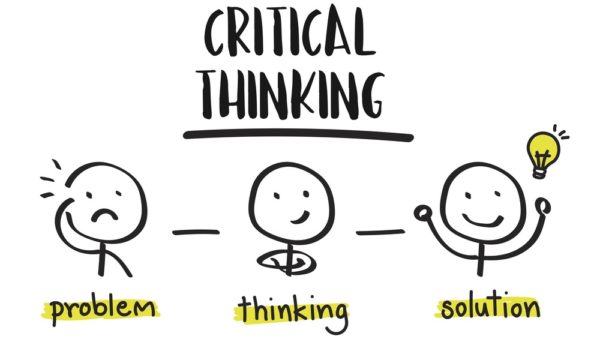
Critical Thinking (Photo Credit: eSchool News)
Some people think developing “critical thinking” capability is really critical. By following proper approaches and practices, it is easy to develop. In this article, we try to explore what “critical thinking” really means and how we can develop it.
What does “Critical Thinking” mean?
Critical thinking is the ability to:
- analyze information objectively,
- evaluate evidence logically,
- identify assumptions and biases,
- and make reasoned decisions instead of reacting emotionally or blindly accepting information.
In modern work and life, critical thinking matters more than memorization. It involves actively questioning assumptions, recognizing biases, and synthesizing information rather than accepting claims at face value.
In single word, critical thinking means: “Thinking carefully, logically, and independently before believing, deciding, or acting.”
Nature of Critical Thinker
Instead of asking: What should I think?
A critical thinker asks:
- Why is this true?
- What evidence or data supports this?
- What assumptions are being made?
- Are there alternative explanations?
- What could go wrong?
This means a critical thinker is always curious about asking questions, finding the alternatives, evaluating cause vs. consequences, and choosing the best solution possible.
Signs of a Weak Critical Thinker
- Believes everything immediately
- Relies only on emotions
- Avoids questioning authority
- Jumps to conclusions
- Cannot explain reasoning
- Confuses opinion with fact
- Ignores evidence
- Thinks in extremes (“always”, “never”)
Signs of a Strong Critical Thinker
- Curious
- Calm under uncertainty
- Asks good questions
- Changes opinion when evidence changes
- Thinks in probabilities
- Evaluates trade-offs
- Distinguishes facts from assumptions
- Can explain reasoning clearly
Why Critical Thinking Is Important?
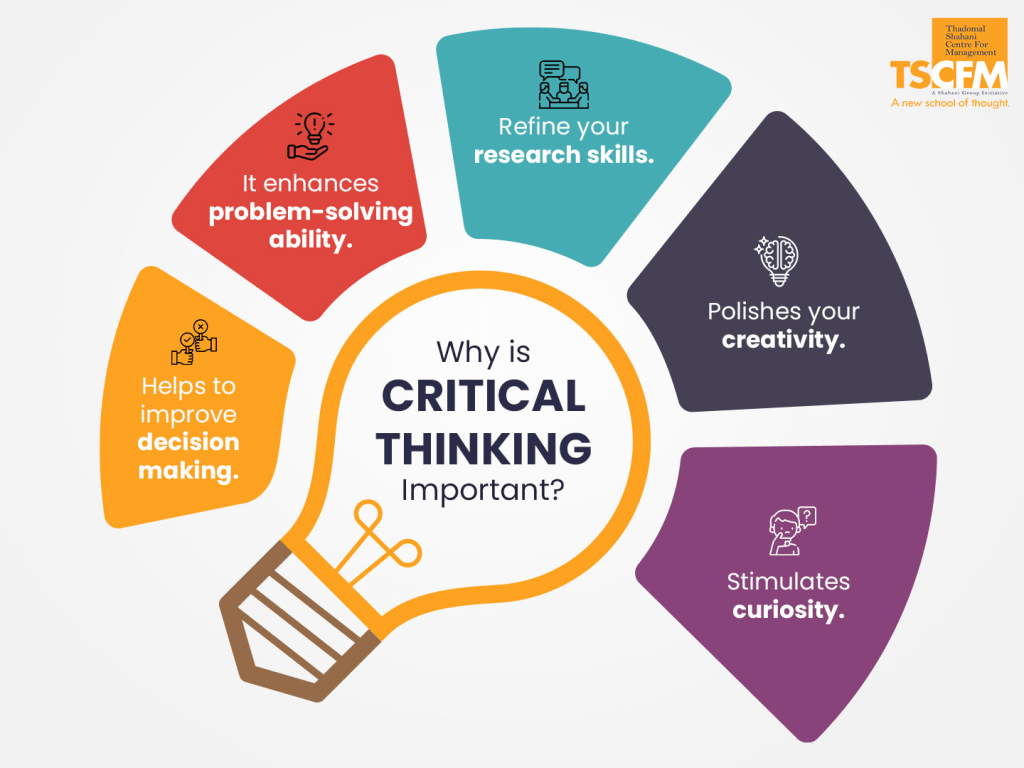
Importance of Critical Thinking (Photo Credit: TSCFM)
- It helps to improve decision-making
- Enhances problem-solving ability
- Builds deeper understanding
- Refine research skills
- Enhances communication skills
- Polishes creativity
- Stimulates curiosity
- Promotes independent learning
- Reduces costly mistakes
- Better incident handling
How Much We Can Do?
As a human being, we can’t do everything. We have limitations of time and resources.
In reality we follow a simple rule:
our ability to do = (bottlenecks * problems) / limited time
In limited time, we can achieve more productivity, if we can reduce maximum bottlenecks and solve more problems.
To maximize this ratio:
- Focus: Decrease the size of the denominator (Time) by doing deep, uninterrupted work blocks.
- Expansion: Increase the numerator by breaking large problems into sequential steps, which helps you clear multiple bottlenecks without feeling overwhelmed.
Understanding Cause Vs. Consequences
- causes: symptoms that problematic.
- consequences: new problems due to the recommendation.
Identify causes, then figure out the real reason behind them. Based on the identifications, generate a recommendation. Make sure the recommendation does not create any problems further. Because if the recommendation creates new bottlenecks, then it reduces our productivity based on the above rule.
Use 5 why techniques to identify causes and 7 so-what’s techniques to identify consequences. It should help you identify the causes, reasons behind them, and the consequences.
Core Components of Critical Thinking
Mastering critical thinking relies on several key mental disciplines:
1. Observation
Carefully noticing facts, patterns, behaviors, and details. Challenge the existing model.
Example:
- A server CPU suddenly spikes every night at 2 AM.
- Instead of guessing, you investigate logs, jobs, and traffic patterns.
2. Analysis
Breaking complex problems into smaller understandable parts. Analysis through high road and low road technique.
Example:
In a production outage investigate:
- Network?
- Database?
- Application?
- DNS?
- Load balancer?
You isolate the real root cause instead of panicking.
3. Logical Reasoning
Connecting facts logically. Use 80/20 principle.
Example:
- High latency started after deployment.
- Logs show DB connection pool exhaustion.
- Therefore, deployment likely introduced inefficient queries.
4. Questioning Assumptions
Not accepting things blindly.
Example:
Instead of:
- “Kubernetes is always better.”
Ask:
- Better for what?
- At what scale?
- What are the trade-offs?
- Does the team have expertise?
5. Evidence-Based Thinking
Using facts and data instead of opinions.
Example:
Bad:
- “I feel this architecture is good.”
Better:
- “Load tests show it handles 20k RPS with acceptable latency.”
6. Bias Awareness
Understanding that humans naturally think irrationally sometimes.
Examples:
- Confirmation bias
- Ego bias
- Authority bias
- Emotional reasoning
Critical thinkers actively challenge their own beliefs.
7. Decision Making
Choosing the best possible option after evaluating alternatives.
Example:
Not:
- Perfect decisions
But:
- Reasoned and informed decisions
Critical Thinking Framework
A practical framework for critical thinking:
Step 1 — Understand the Problem
Ask:
- What exactly is the problem? (Goal)
- For whom we are going to solve the problem (Stockholders)
- Do we have available data? (Metrics)
- What constraints exist? How much should we address or solve the problem? (Boundaries)
- What are we trying to achieve? (Success Criteria)
Step 2 — Gather Information
Collect:
- Facts
- Data
- Logs
- Metrics
- Evidence
- Context
Step 3 — Identify Assumptions
Ask:
- What are we assuming?
- Could those assumptions be wrong?
Step 4 — Generate Alternatives
Avoid binary thinking.
Instead of:
- “Should we use Docker or not?”
Think:
- Docker
- VMs
- Managed services
- Hybrid approach
Step 5 — Evaluate Trade-offs
Every solution has:
- Pros
- Cons
- Risks
- Costs
- Complexity
Step 6 — Make a Decision
Choose the best option based on:
- Evidence
- Constraints
- Risks
- Goals
Step 7 — Reflect Afterwards (Consequences)
Ask:
- What worked?
- What failed?
- What did we miss?
- How can we improve?
Reflection builds wisdom.
How to Develop Critical Thinking
There hasn’t been any definite answer. But, in general, we can follow the below:
1. Ask Better Questions
The quality of your thinking depends on the quality of your questions.
Useful questions:
- Why?
- How do we know?
- What evidence exists?
- What assumptions are hidden?
- What are alternative explanations?
- What are the trade-offs?
- What could fail?
2. Read Deeply, Not Just Quickly
Read:
- Books
- Technical blogs
- Case studies
- Postmortems
- Research papers
Then ask:
- Do I agree?
- Why?
- What are weaknesses in this argument?
3. Practice Problem Solving
Critical thinking improves through use.
Good activities:
- Debugging systems
- System design
- Chess
- Competitive programming
- Architecture reviews
- Incident analysis
4. Learn Logic and Reasoning
Basic knowledge of:
- Deductive reasoning
- Inductive reasoning
- Logical fallacies
- Probabilistic thinking
is extremely valuable.
Example fallacies:
- Strawman
- False dilemma
- Ad hominem
- Appeal to authority
5. Analyze Real Incidents
Especially valuable for engineers.
Read:
- Engineering postmortems
- Outage analyses
- Failure reports
Ask:
- What caused this?
- What assumptions failed?
- What safeguards were missing?
Companies like Google SRE and Cloudflare Blog publish excellent engineering analyses.
6. Debate Ideas, Not People
Strong thinkers:
- Challenge ideas respectfully
- Separate emotion from analysis
- Seek truth, not victory
7. Slow Down Important Decisions
Bad decisions often come from:
- Hurry
- Ego
- Fear
- Assumptions
Important decisions deserve:
- Reflection
- Data
- Alternative analysis
8. Write More
Writing exposes weak thinking.
Try:
- Technical blogs
- Decision documents
- Architecture notes
- Personal reflections
If you cannot explain something clearly, you may not fully understand it.
9. Learn From Multiple Perspectives
Avoid echo chambers.
Read from:
- Different experts
- Different industries
- Different opinions
This improves intellectual flexibility.
10. Develop Intellectual Humility
One of the strongest traits of critical thinkers:
“I might be wrong.”
This mindset accelerates learning.
Resources:
Books:
- Thinking, Fast and Slow
- The Demon-Haunted World
- Super Thinking
- Decisive
- The Art of Thinking Clearly
- Engineering Thinking
- The Pragmatic Programmer
Course:
- LinkedIn Learning Path: Develop Critical Thinking, Decision-Making, and Problem-Solving Skills