Detailed Design Patterns Series:
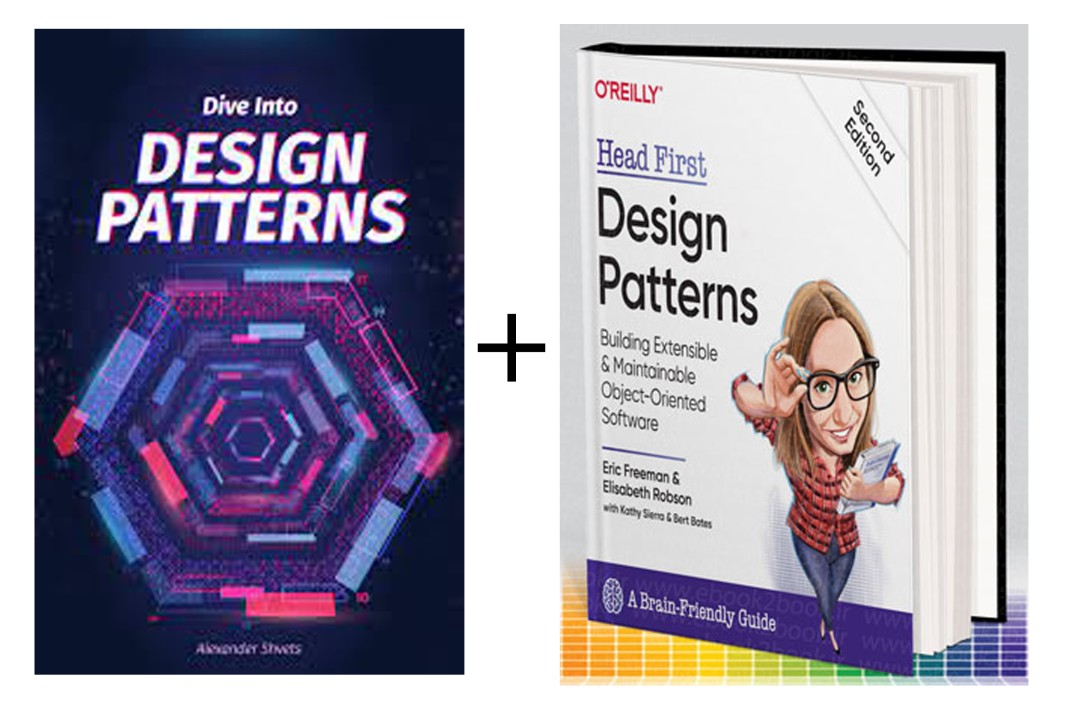
Head First Design Pattern + Dive Into Design Pattern (Photo Credit: myself)
Book introduction
“Head First Design Pattern” by Eric Freeman and Elisabeth Robson, a classical book published in 2004, is a book about software design patterns. After publishing the book, it becomes very popular for its simplicity and fun way of presentation. It demonstrates and simplifies complex topics like design patterns by its strong visuals and narrative styles. Also, unlike other books, it only discusses the most used 13-15 design patterns. It’s a very beginner-friendly book for learning design patterns. Just love it.
“Dive Into Design Pattern” by Alexander Shvets is also about the design patterns first published in 2018. It can be said to be a hard copy version of the refactoring.guru website. It is an intermediate-level book. After publishing the book, it also becomes very popular because of the content and its target audience. This book also uses visuals, drawings, and diagrams, which is so intentionally revealing. It is a complete package of GOF design pattern explanations.
About Author
Alexander Shvets is the author of “Dive Into Design Pattern” and the owner and maintainer of the refactoring.guru website. He is also the author of the book “Dive into Refactoring.” Besides this, he is the CEO of Shvets Group.
Eric Freeman creates and produces content for today’s leading educational channels. His content is available on the premier O’Reilly and LinkedIn Learning/Lynda.com content channels, and he produces content for a number of private-label clients. Eric also co-directs the Head First series at O’Reilly Media. Previously Eric was CTO/Vice President of Technology for Disney Online. He’s also the co-author of several bestselling technology titles, including Head First Design Patterns and Head First HTML & CSS.
Elisabeth Robson is an author, software developer, and computer scientist. With five titles on software development, Elisabeth is a top-selling author with over a half million books in print. She teaches on software topics at lynda.com and at O’Reilly’s Safari Books Online and is co-founder of WickedlySmart, a software training company. Elisabeth holds a master’s degree in computer science from Yale University. Previously she was Director of Special Projects at O’Reilly Media and Director of Engineering at The Walt Disney Company.
High-level Overview
Head First Design Pattern:
It aims to introduce design patterns in software development in an engaging and accessible manner. The book utilizes a unique approach that blends visual aids, humor, and practical examples to convey complex concepts effectively.
Here’s a high-level overview of the book:
- Introduction to Design Patterns: The book starts with an introduction to design patterns, explaining why they are essential in software development and how they help in creating flexible, reusable, and maintainable code.
- Understanding Design Principles: Before delving into specific patterns, the book covers fundamental design principles such as encapsulation, inheritance, and polymorphism. These principles lay the groundwork for understanding design patterns effectively.
- Categorization: The book then explores creational design patterns, which focus on object creation mechanisms. Next, the book dives into structural design patterns, which deal with object composition and class structure. Then proceeds to discuss behavioral design patterns, which focus on communication between objects.
- Real-World Examples and Case Studies: Throughout the book, real-world examples and case studies are provided to illustrate how design patterns are used in practical software development scenarios. These examples help readers understand how to apply patterns in their own projects.
- Anti-Patterns and Pitfalls: The book also highlights common anti-patterns and pitfalls that developers may encounter when applying design patterns. By understanding these pitfalls, readers can avoid potential pitfalls and make better design decisions.
- Design Patterns in Context: Towards the end, the book discusses how design patterns fit into the larger context of software architecture and development methodologies. It emphasizes the importance of choosing the right pattern for the problem at hand and integrating patterns into the overall design strategy.
- Review and Reinforcement: Throughout the book, review exercises, quizzes, and puzzles are included to reinforce learning and help readers solidify their understanding of design patterns.
Dive into Design Pattern:
It is a comprehensive guide aimed at software developers seeking a deeper understanding of design patterns and their practical applications. The book delves into various design patterns commonly used in software development, providing insights into their purposes, implementations, and best practices.
Here’s a high-level overview of the book:
- Introduction and Understanding Design Principles: The book begins by introducing the concept of design patterns and their importance in creating flexible, maintainable, and scalable software systems. It covers fundamental principles such as abstraction, encapsulation, inheritance, and polymorphism, which form the basis of design pattern discussions.
- Categorization: As readers progress through the book, they explore a wide range of design patterns categorized into three main groups: creational, structural, and behavioral patterns. Each pattern is presented with clear explanations, code examples, and illustrations to aid comprehension.
- Explanation: “Dive into Design Patterns” is not just a theoretical exploration of design patterns; it also provides practical insights into real-world scenarios where these patterns can be applied to improve software design, readability, and maintainability.
- Conclusion: By the end of the book, readers gain a solid understanding of design patterns and how to leverage them to write cleaner, more modular, and more maintainable code, making it an essential resource for software developers at all levels of expertise.
Insights and Learning
Choosing the correct design pattern in software engineering is critical to practical problem-solving. So in the right moment, right scenario, and right design pattern, use can be a lifesaver. So to deal with:
Object Creation → Creational Patterns:
- Singleton: Ensures only one instance exists.
- Factory Method: Delegates object instantiation to subclasses.
- Abstract Factory: Creates related object families without specifying their concrete classes.
- Prototype: Clones objects for a prototypical instance.
- Builder: Constructs complex objects step by step.
Object Assembly/Structuring → Structural Patterns:
- Adapter: Bridges incompatible interfaces.
- Bridge: Separates abstraction from implementation.
- Composite: Treats single and composite objects uniformly.
- Decorator: Adds behaviors to objects dynamically.
- Façade: Simplifies complex system interfaces.
- Flyweight: Shares objects to reduce memory.
- Proxy: Controls object access.
Object Interactions/Behavior → Behavioral Patterns:
- Observer: Notifies changes to multiple objects.
- Strategy: Encapsulates interchangeable algorithms.
- Command: Encapsulates a request as an object.
- State: Changes object behavior with internal state.
- Visitor: Adds operations to object structures without modifying them.
- Memento: Captures and restores object states externally.
- Iterator: Sequentially accesses elements of a collection.
- Mediator: Centralizes complex communications.
- Chain of Responsibility: Passes requests along a chain of handlers.
- Template Method: Defines the skeleton of an algorithm.
Conclusion
A design pattern is nothing but the common, well-known solution to a well-known situation in our day-to-day software development. These 2 books are very good for making your understanding about the design pattern from beginner to intermediate (with advanced experience also) level. But as you know, design pattern is not a straightforward thing and not so easy to understand; we should feel them and use them wisely in appropriate places only when needed.